
Pre-Pay Run Automated Reports: The Essential Governance Tool Every Australian Business Owner and Executive Must Prioritise in 2026
- Jul 8
- 6 min read
Just one (1) undetected Payroll exception can quietly cost your Business hundreds of thousands — or even worse...
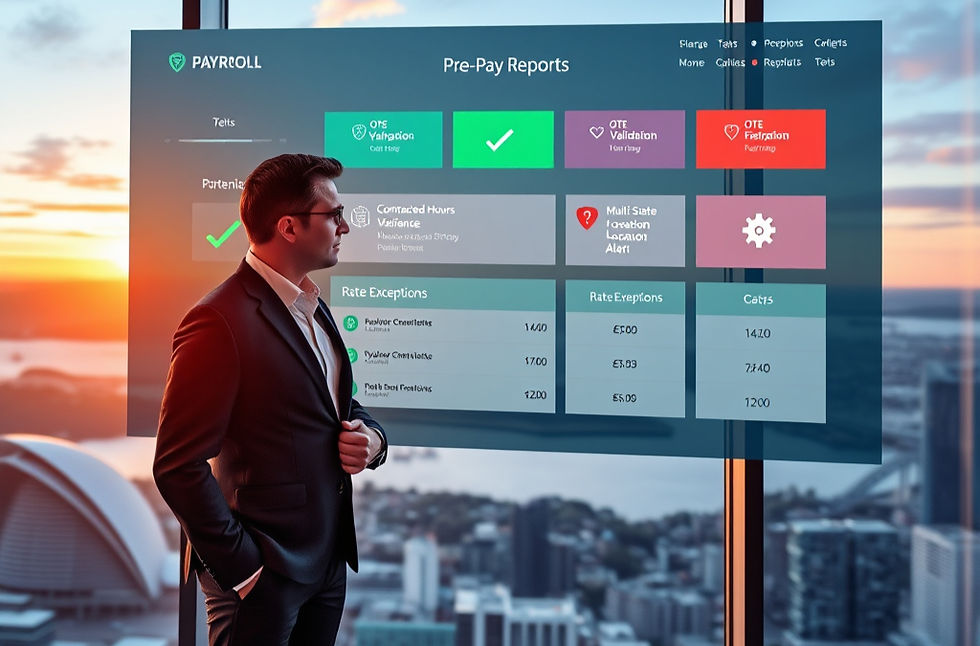
Whether it’s an unreported Employee Inter-State/Territory move, an incorrect leave accrual, hours variance, missed contract end date, miscalculated superannuation, wrong Award classification or unnotified changes in an Employee's position/terms, these silent failures often remain hidden UNTIL AFTER the pay run.
The Result? Substantial underpayments or overpayments, Fair Work claims, ATO penalties, unexpected State/Territory liabilities, Director exposure and in extreme cases, Business closure — which ultimately affects all Workers in the Business at the end of the day.[1]
Forward-thinking Australian Business Owners and Executives NO longer tolerate reactive, manual Payroll processes. They demand robust automated pre-pay run reports that identify and eliminate risks before any payment is processed.
This is just NOT an 'Operational' Detail — it is a Strategic Governance imperative for every Business Leader responsible for protecting Enterprise value, Shareholder interests and Personal exposure.
Why Pre-Pay Run Automated Reports Are Now a Board-Level Priority
Since Payday Super commenced on 1 July 2026, the ATO receives near real-time Payroll data, significantly increasing detection risk.[2] Combined with Fair Work’s continued focus on wage compliance and the growing prevalence of Multi-State/Territory workforces, the margin for error has never been smaller. Unchecked issues can escalate rapidly into six- and seven-figure remediation costs, adverse media coverage, loss of key talent, Regulatory sanctions and — in the most serious instances — forced Business closure.
Strong Pre-Pay Reporting shifts Payroll from what may seem to many as just a back-office function into the most proactive control mechanism that safeguards financial integrity and reduces the risk of any ASIC Registered Director of the Business.
11 Critical Automated Reports Every Executive Overseeing Payroll Compliance MUST Demand
Modern Payroll/HR platforms should automatically deliver clear, exception-based reports before EVERY pay cycle. The following have become non-negotiables in 2026 for many Executives:
Contracted Hours vs Actual Hours Variance Report - identifies material deviations that can lead to underpayment claims or unsustainable cost creep.
Overtime & Additional Hours Report - highlights threshold breaches for correct rate application and early fatigue risk visibility.
Fatigue Risk Indicators Report - flags excessive hours, consecutive shifts or inadequate rest periods — critical for meeting WH&S obligations and avoiding liability.[3]
Leave Accrual Validation Report - ensures accruals align precisely with the Employee’s Award, classification and ordinary hours — a frequent source of costly underpayment disputes.
Ordinary Time Earnings (OTE) Validation Report - confirms that Superannuation is calculated on the Correct Earnings Base. Misclassification of allowances, loadings, bonuses and certain payments is one (1) of the MOST common causes of Super underpayments, particularly under the new Payday Super regime.[4]
Final Pay & Termination Entitlements Report - surfaces accurate calculations for accrued Leave Payouts, Notice Pay, Redundancy entitlements and any other Departure Payments before processing — a high-risk area that frequently leads to significant back-pay claims.
Award Classification & Higher Duties Report - flags Employees paid at the incorrect Classification level or NOT receiving the correct Higher Duties Rate when temporarily performing higher-level work.
Position & Terms of Employment Change Report - automatically detects when an Employee’s Role (e.g. Position Title, Employment Status or Terms and Conditions) have changed BUT the Payroll System has NOT been updated in time.
Multiple Employment Arrangements Report - identifies Employees working in dual or multiple role capacities (e.g. Casual in one (1) Department and Part-Time in another) to ensure the correct pay rules, loadings, leave accruals and Super calculations are applied across all arrangements.
Rate, Penalty & Allowance Exceptions Report - automatically identifies incorrect penalty rates, loadings, shift allowances, minimum engagement payments or missing entitlements before they flow into the General Ledger (GL). This prevents inaccurate Expense Allocation across Cost Centres (CC), reduces Month-End Reconciliation effort for the Finance Team, minimises the need for Manual Journals and reclassifications, and protects the overall integrity of Financial reporting and Business forecasting.
Employee Location / Address Change Detection Report (Multi-State Compliance Alert) - automatically flags any Inter-State/Territory move of Employees, prompting immediate review of the Employee's agreed Terms and Conditions of Employment and NEW Business obligations and impact (Financial and Regulatory).
The Significant Business Risk of an Unreported Inter-State/Territory Employee Move
It is unforeseen by many, but a number of issues often create more unexpected exposure to the Employer if an Employee relocates without notifying or discussing their existing Contractual Terms and Conditions with the Employer beforehand.
Because key obligations are State/Territory-based, an unreported Employee move can silently activate new significant Business requirements, including:
Payroll Tax Registration in the new Jurisdiction (even on relatively modest wages) —Late Registration attracts penalties and interest. Full details are covered in our earlier post: Payroll Tax in Australia: State-by-State Variations, Compliance Challenges & What Every Owner / Executive Must Know in 2026.
Workers’ Compensation (WorkCover) Insurance — potentially requiring a new Policy in the Employee’s “State of Connection”, with significant fines and Personal Liability for Non-Compliance.
Public Holiday Entitlements — based on where the Employee is based for work purposes.[5]
Long Service Leave and other State/Territory-specific rules.
Many Executives usually ONLY become aware of these issues during an Audit or Claim — often when the Financial and Operational impact has already become severe - is that even really fair today?
Real-World Lessons from Major Payroll Failures
Recent and historical cases demonstrate the massive cost of inadequate pre-pay controls. In April 2026, Aged Care Provider Southern Cross Care (NSW & ACT) entered an Enforceable Undertaking with the Fair Work Ombudsman after underpaying more than $11.7 million to 5,500 staff. The issues largely arose from complex Enterprise Agreement Interpretations, Time & Attendance System limitations and manual Payroll processes.[6]
This mirrors the lessons from the landmark Queensland Health Payroll System failure (2010), which cost the State of Queensland more than $1.2 billion and left over 78,000 Employees receiving incorrect and sometimes no payment at times for months given the manual System work-arounds required to support post-implementation system configurations and accepted defects.[7]
These high-profile System Implementation failures also highlight the heavy burden now placed on Payroll System Vendors. With frequent Fair Work Decisions, Award variations, and Legislative changes, Vendors face enormous ongoing workloads to Configure, Test and Deploy updates across thousands of Business rules. Even the most well-known Payroll Vendors struggle to keep pace manually today, which is why intelligent, rules-based automation inside the Payroll platform has become critical for both Employers and Vendors alike.
Recommended Actions for Business Owners and Executives Overseeing Payroll Compliance
Commission an immediate audit of your current Payroll system’s pre-pay reporting capabilities. Test a full cycle and document existing gaps.
Elevate Employee location data to a controlled field with mandatory notification within 7–14 days of any change.
Define mandatory pre-pay reports for your Business — explicitly including hours variance, leave validation, OTE/Super calculations, position/terms changes, multiple Employment arrangements, Contract end dates, End of Employment payments and Multi-State/Territory Location Alerts.
Establish formal escalation protocols — ensuring material exceptions (especially Inter-State/Territory moves and large variances) reach Executive oversight immediately.
Incorporate pre-pay exception summaries into your monthly Executive and Board Reporting Pack for transparent Risk Visibility.
Institute regular data quality reviews focussing on Agreed Contracted Hours, Awards, Classifications, Locations, Employment Terms and Conditions and Contract End Dates.
Integrate these controls with your Delegations Register to ensure appropriate Authority and Accountability at every Level.
How the Right Payroll System Delivers Strategic Advantage
Leading Systems in 2026 operate as intelligent Governance layers. They automatically apply Legislative and Award rules, generate actionable pre-pay reports, detect location changes, position updates, multiple arrangements and OTE anomalies in real time, maintain comprehensive Audit trails and prevent finalisation until exceptions are resolved.
This transforms Payroll into a value-protecting function that strengthens compliance, reduces cost leakage and supports confident Business scaling.
Payroll remains one (1) of the largest controllable costs — and one (1) of the highest sources of Enterprise Risk — in Australian Businesses today.
Do NOT wait for the next Fair Work investigation, ATO Notice, unexpected Multi-State/Territory liability or a compliance failure that threatens the future of your Business and Workforce.
Implement strong pre-pay run automated reports and the supporting technology NOW to protect your Business, your people and your personal position as a Leader.
Is it time to compare?
Access the RUNPAY® Compare Marketplace for 5-day access or book a targeted Executive Advisory Session.
References
Fair Work Act 2009 (Cth) – National Employment Standards.
https://www.fairwork.gov.au/employment-conditions/national-employment-standards
Australian Taxation Office – Single Touch Payroll reporting under Payday Super.
Safe Work Australia – Model Code of Practice: Managing the risk of fatigue at work.
https://www.safeworkaustralia.gov.au/doc/model-code-practice-managing-risk-fatigue-work
Australian Taxation Office – List of payments that are Ordinary Time Earnings (OTE).
Fair Work Ombudsman – Public holiday entitlements.
https://www.fairwork.gov.au/employment-conditions/public-holidays
Fair Work Ombudsman – Southern Cross Care (NSW & ACT) signs Enforceable Undertaking after $11m underpay (2 April 2026). https://www.fairwork.gov.au/newsroom/media-releases/2026-media-releases/april-2026/20260402-southern-cross-care-nsw-and-act-eu-media-release
Queensland Health Payroll System Commission of Inquiry Report (2013). https://cabinet.qld.gov.au/documents/2013/aug/health%20payroll%20response/Attachments/Report.pdf


